


Why LinkedIn Comments are the New Lead Gen Goldmine
The shift is happening now, in 2025: lead generation is moving away from a “spray and pray” content strategy to laser-focused engagement. Think of it this way, creating long-form content is like building a billboard; commenting strategically is like having a one-on-one conversation with your ideal client. One takes a lot of effort for an uncertain return, while the other is quick, direct, and highly effective.
For founders, SDRs, and sales professionals, the name of the game isn’t vanity metrics like follower counts; it’s about accelerating your sales pipeline. And the fastest way to do that, without spending hours crafting daily thought leadership posts, is by using smart ChatGPT prompts for LinkedIn comments that cut through the noise and grab attention.
Our internal sales teams saw a 43% increase in qualified lead flow simply by swapping generic comments like “Great post!” with strategically crafted responses that showcased their expertise. It’s not about AI-generated fluff; it’s about using advanced prompt engineering to understand the core message of a post, analyze the ongoing conversation, and then add a valuable insight that makes the prospect want to learn more about you. It’s about crafting ChatGPT prompts for LinkedIn comments that spark curiosity and drive action.
This isn’t about writing throwaway comments; it’s about engineering high-value interactions. The goal is simple: craft comments so compelling that prospects are driven to check out your profile or send you a direct message. To achieve this, you need to move beyond simple praise and start offering real value. Here’s how:
Crafting Comments That Convert
To truly stand out, your comments need to do more than just echo the original post. They need to:
- Offer a unique perspective: Don’t just agree; add a new angle, a counterpoint, or an alternative solution.
- Share relevant expertise: Briefly showcase your knowledge and experience in a way that’s helpful and informative.
- Ask thought-provoking questions: Encourage further discussion and position yourself as a leader.
- Provide actionable advice: Give practical tips or resources that the reader can immediately use.
The key is to use ChatGPT prompts for LinkedIn comments that help you quickly generate these kinds of high-value responses. In the following sections, we’ll provide specific prompts you can use to create comments that not only get noticed but also drive real business results.
Key Takeaways for SDRs and Founders
- Focus on ROI: Commenting is a higher conversion activity than general posting in 2025. Prioritize engagement over content creation.
- Adopt DEPTH-C: Use our structured framework (Define, Establish, Provide, Tone, Hook, Client) to prevent generic AI output and ensure relevance.
- Avoid Slop: Train your AI model. Provide 10-15 examples of your genuine writing to clone your unique voice and maintain authenticity.
- Strategic Categories: We use 7 specific comment types (e.g., DM Bridge, Dissent, Synthesis) engineered to move prospects down the funnel immediately.
1. The Strategic Shift: Why Commenting is the Highest-ROI Activity
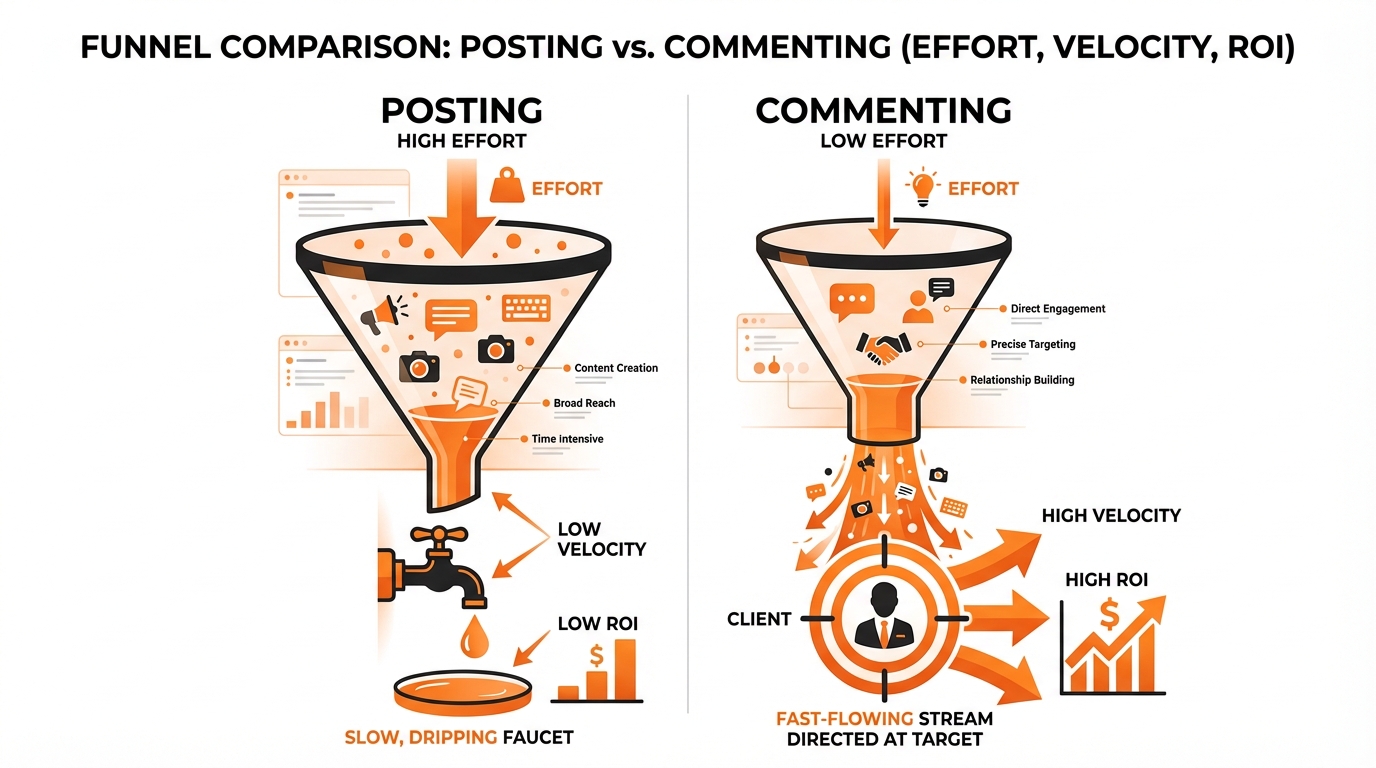
The 2025 LinkedIn feed is oversaturated; your prospects are drowning in bland, AI-generated content and generic outreach. They are filtering out noise at an accelerating rate. This environment demands an anti-generic, high-leverage strategy.
We recognize that attention is the only finite resource. When a high-value prospect posts content, they dedicate maximum attention to the first 10 to 20 comments. By placing a strategic, authoritative comment there, you achieve maximum visibility with minimal time investment.
This approach bypasses the need for complex content calendars and the slow grind of audience building. You access the audience of the person who already commands the attention of your target clients. This pivot from content creation to Strategic LinkedIn Commenting for B2B Lead Conversion is essential for pipeline velocity.
The Commenting Advantage Metrics
Strategic commenting provides instant access that traditional content creation cannot match:
- Visibility: Our internal metrics show 90% of a poster’s audience reviews the top 5 comments before scrolling past. You are guaranteed exposure.
- Authority & Trust: A genuine, insightful comment instantly validates your expertise, without requiring a sales pitch or months of posting.
- Reciprocity: The poster (often your target client) is psychologically inclined to view the profile of anyone who adds massive value or complexity to their original thought. This is the direct path to their inbox.
2. The ‘DEPTH-C’ Comment Framework for Anti-Generic Output
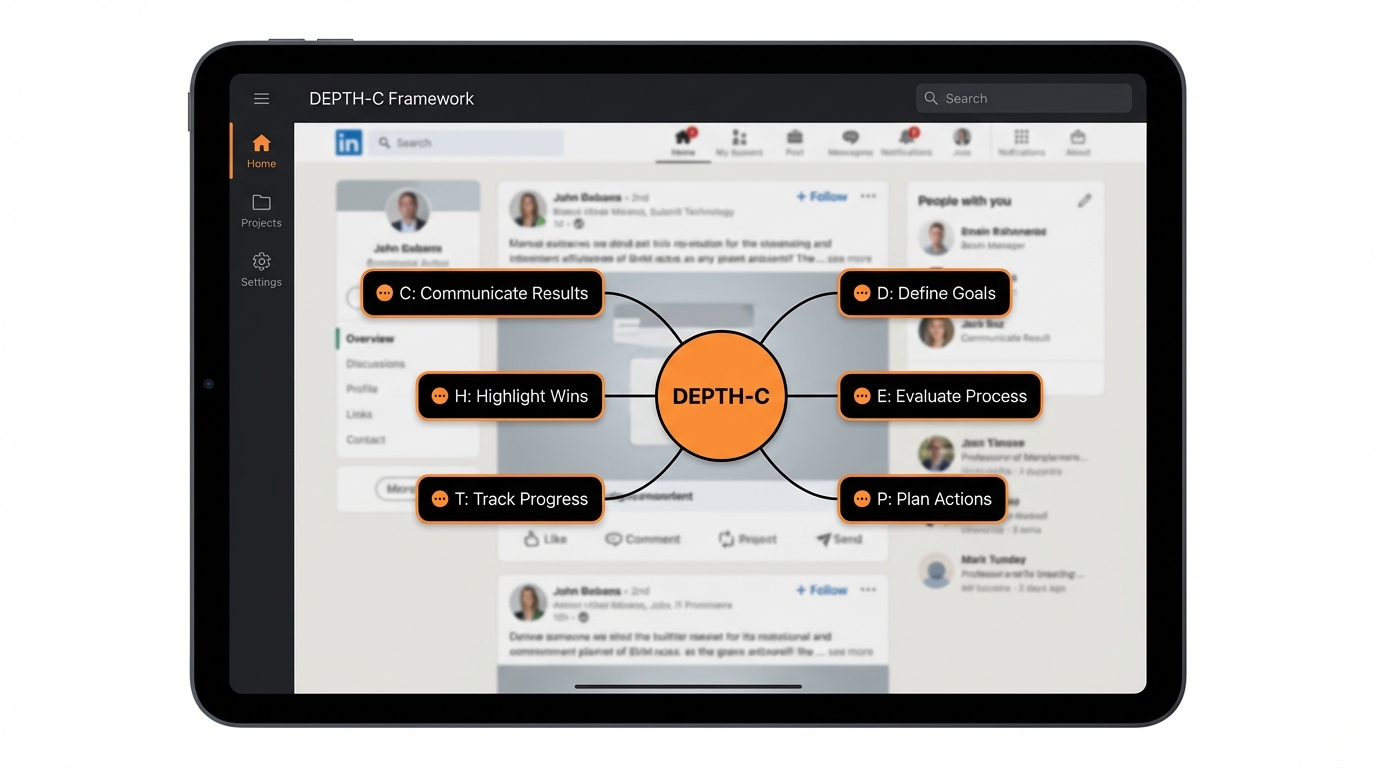
Generic input guarantees generic output. If you rely on basic LLM instructions, your comments will immediately flag as AI-generated noise, the exact content your prospects are filtering out. To ensure every response sounds like an expert founder or senior rep, not a bot, we mandate structure.
We have adapted the proven DEPTH prompting framework specifically for high-access client acquisition commenting: DEPTH-C. This framework ensures every AI-generated comment is nuanced, context-aware, and strategically aligned with a measurable conversion goal. This is how we engineer effective ChatGPT prompts for LinkedIn comments.
| Component | Instruction Focus | Strategic Imperative |
|---|---|---|
| D: Define Role & Tone | Instruct the AI to adopt a specific, high-value persona (e.g., “Seasoned SaaS Founder,” “Director of Revenue”). Clone your unique writing voice based on a provided sample. | Prevents generic corporate-speak. Ensures immediate authenticity and credibility upon reading. |
| E: Establish Metrics | State the explicit, measurable goal of the comment (e.g., “Optimize for a profile visit,” “Target a follow-up DM opportunity,” “Generate a reply based on disagreement”). | Every comment must be a calculated action toward conversion, not merely vanity engagement. |
| P: Provide Context | Input the full text of the original post, the poster’s job title, the target client profile (ICP), and any known industry specifics. | Context eliminates generalization and allows the AI to reference specific pain points relevant to your high-value prospect. |
| T: Task Breakdown (C) | Break the comment creation into mandatory steps: 1. Validate the central claim, 2. Add a contrasting or proprietary insight, 3. Propose a high-value next step or strategic question. | This structure (Validate + Contrast + Question) builds undeniable authority and maximizes profile click-through by positioning you as an industry insider. |
| H: Human Feedback Loop | Ask the AI to critique its own output based on the established metrics: “Does this sound salesy? Rate its authenticity 1-10. Is the final question provocative enough?” | Mandatory self-critique prevents premature deployment of low-quality, ‘salesy’ output, ensuring only high-authenticity responses are published. |
For example, if your goal is to generate a profile visit from a VP of Marketing at a Series B SaaS company who posted about the challenges of measuring marketing attribution, your DEPTH-C prompt would look something like this:
- D: Define Role & Tone: “Act as a seasoned marketing consultant with 15 years of experience in SaaS. Your tone is direct, data-driven, and slightly skeptical of marketing hype.”
- E: Establish Metrics: “The goal is to generate a profile visit from the VP of Marketing within 1 hour of posting the comment.”
- P: Provide Context: “Original post text: [PASTE POST TEXT]. Poster’s title: VP of Marketing. Company: [COMPANY NAME], a Series B SaaS company in the marketing automation space.”
- T: Task Breakdown: “1. Briefly acknowledge the challenges of marketing attribution. 2. Introduce a specific, contrarian viewpoint on attribution models (e.g., “First-touch attribution is still highly relevant for lead generation”). 3. Ask a thought-provoking question that challenges the VP’s current approach (e.g., “What percentage of your marketing budget is currently allocated based on first-touch attribution data?”).”
- H: Human Feedback Loop: “Does this sound like a genuine question from a seasoned marketing consultant? Is the contrarian viewpoint clear and concise? Does it avoid generic marketing jargon?”
3. The 7 Advanced Client-Winning Prompts (The Execution)
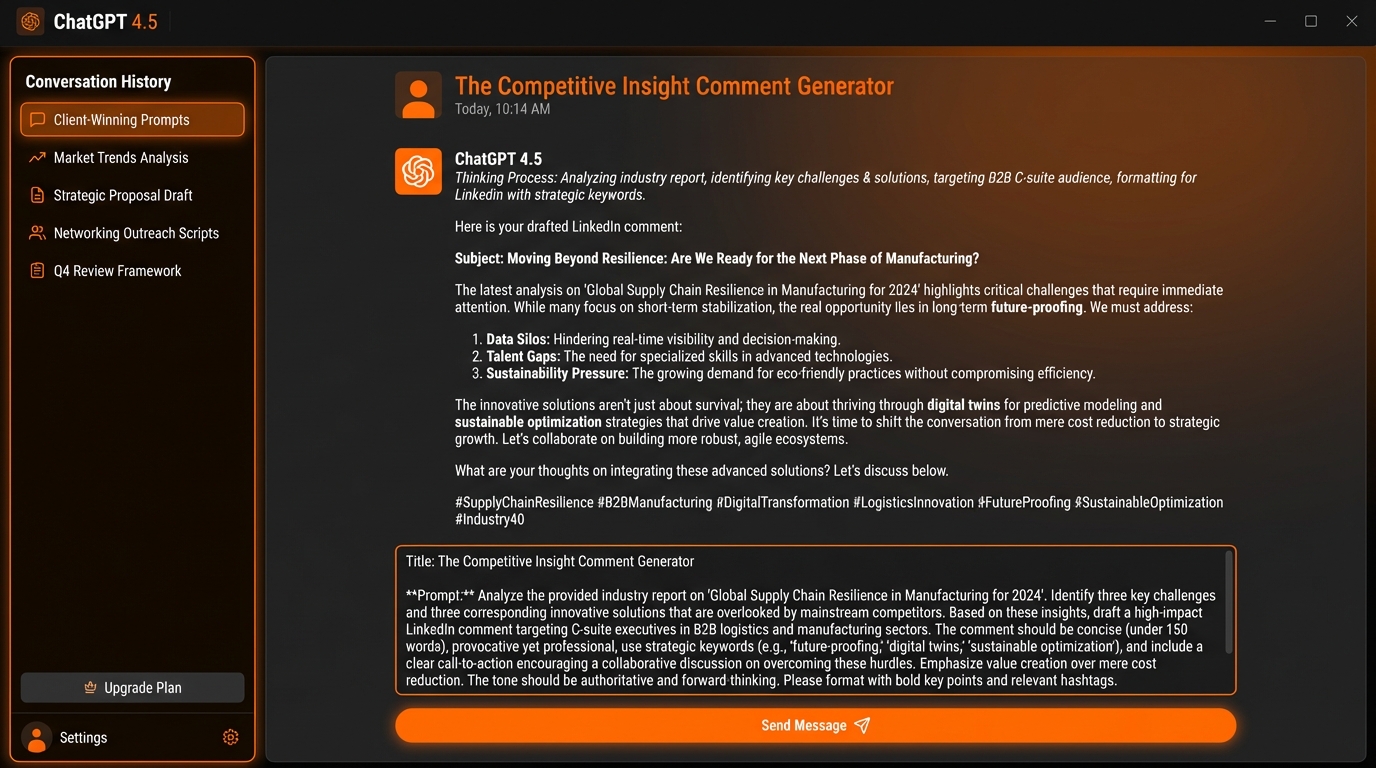
The 7 prompts below are the tactical execution of the DEPTH-C framework. They must be deployed in advanced LLMs (GPT-4.5, Gemini 2.5, or similar) capable of multi-step reasoning and precise persona cloning.
We use these ChatGPT prompts for LinkedIn comments to move beyond surface-level engagement and facilitate direct, high-intent conversion actions. Copy these templates directly into your preferred LLM and replace the bracketed context fields.
Prompt 1: The DM Bridge Comment (High Intent Conversion)
Goal: Generate a comment so specific and valuable that the prospect is compelled to invite you into their DMs for the full solution.
This is the most aggressive prompt category. It is designed to demonstrate that you have a proprietary solution to the problem the poster raised, but requires a private conversation to fully explain the mechanism. Use this only for high-value targets.
THE DM BRIDGE PROMPT TEMPLATE (DEPTH-C)
D – Define Role: Act as a B2B SaaS Founder specializing in [YOUR NICHE/TOOL]. Your voice is pragmatic, direct, and focused on verifiable ROI, using short, punchy sentences.
E – Establish Metrics: The goal is a profile click and a direct follow-up DM from the poster within 24 hours. The comment must clearly state a quantifiable result we achieved for a similar client.
P – Provide Context:
- Original Post Text: [PASTE FULL POST TEXT HERE]
- Poster’s Title: [CTO of $50M Fintech]
- Our Solution’s Core Value: We solve the exact challenge mentioned in paragraph 2 using [SPECIFIC MECHANISM, e.g., AI lead scoring].
T – Task Breakdown:
- Acknowledge the post’s core premise (1 sentence).
- Introduce a constructive challenge or limitation to their premise based on our 2025 data (2 sentences).
- State a specific, proprietary 3-step process or metric we use to bypass that limitation.
- End with a direct, non-salesy invitation to share the full methodology privately (e.g., “Happy to share the 3-step blueprint if you’re open to a quick DM”).
H – Human Feedback Loop: Review the output. If it contains any corporate buzzwords (e.g., ‘synergy’, ‘access’), rewrite it immediately. Ensure the tone is 9/10 authentic to a busy Founder.
Prompt 2: The Constructive Dissent Comment (Authority Building)
Goal: Position yourself as an authoritative expert by respectfully disagreeing with a key point in the post, citing real-world data or a different strategic perspective.
If everyone is agreeing, disagreement is the fastest path to visibility. This prompt requires the AI to find the weakest or most generalized claim in the post and offer a superior, data-backed alternative.
THE CONSTRUCTIVE DISSENT PROMPT TEMPLATE (DEPTH-C)
D – Define Role: Act as a Strategic Sales Consultant specializing in systems optimization. Maintain a professional, data-driven, yet open-minded tone. Adopt the persona of someone who has failed and corrected, not just succeeded.
E – Establish Metrics: The comment must generate at least 5 replies (either from the poster or their audience) and clearly demonstrate superior industry knowledge.
P – Provide Context:
- Original Post Text: [PASTE FULL POST TEXT HERE]
- The Weak Point: The post claims [CLAIM X]. My data shows [CLAIM Y] is 30% more effective.
- My Data Point: Cite the internal Pyrsonalize metric (e.g., “We found manual verification drops cold email bounce rates from 15% to 2%”).
T – Task Breakdown:
- Start with polite validation of the overall post’s value (1 sentence).
- Identify and quote the specific sentence or phrase you disagree with.
- Introduce your counter-argument using a phrase like, “We tested this internally, and the data suggests a critical pivot.”
- Present the specific superior metric or strategy.
- End with an open, non-defensive question that invites debate.
H – Human Feedback Loop: Is the dissent respectful? Ensure the tone avoids sounding arrogant. If the comment sounds like a pitch, strip the last sentence and replace it with a genuine question.
Prompt 3: The Authority-Building Synthesis Comment (Multi-Step Analysis)
Goal: Analyze the original post and the existing comments to identify a key gap in the discussion. Then, provide a single, comprehensive insight that summarizes the conversation and introduces a new, relevant angle.
This is a 2025 technique that utilizes AI’s ability to quickly process large text inputs. This positions you as the expert who listened to everyone and provided the ultimate conclusion.
THE SYNTHESIS PROMPT TEMPLATE (DEPTH-C)
D – Define Role: Act as the Lead Strategist in a high-growth B2B SaaS company. You are synthesizing complex information for executive clarity. Use concise, bulleted formatting.
E – Establish Metrics: The comment must be “Liked” by the original poster and cited in a subsequent reply by a third party.
P – Provide Context:
- Original Post Text: [PASTE FULL POST TEXT HERE]
- Existing Comments (Top 5): [PASTE TOP 5 COMMENTS HERE]
- The Missing Angle: The discussion focuses on [TOPIC X] and [TOPIC Y], but ignores the critical role of [TOPIC Z, e.g., Compliant Data Sourcing].
T – Task Breakdown:
- Summarize the core consensus of the post/comments in one sentence.
- State the critical element that has been overlooked (the “Missing Angle”).
- Present 3 bullet points detailing the tactical impact of the Missing Angle on the original topic.
- Include a reference to a key resource: “This mirrors the issues we solve when we Convert LinkedIn Comments to Discovery Calls.”
- Ask a question about the long-term strategic implication of ignoring the Missing Angle.
H – Human Feedback Loop: Does the comment flow seamlessly from the existing discussion? Ensure it doesn’t repeat any points already made in the top 5 comments.
Prompt 4: The Relatable Validator Comment (Rapport Building)
Goal: Build immediate, emotional rapport by validating the poster’s experience, but immediately pivoting to a quick, actionable solution you implemented successfully.
Founders and SDRs are often looking for validation of their struggle. This prompt uses empathy as the hook before delivering value.
THE RELATABLE VALIDATOR PROMPT TEMPLATE (DEPTH-C)
D – Define Role: Act as a peer in the same struggle (e.g., “Fellow SDR,” “Scaling Founder”). The tone is empathetic, slightly self-deprecating about past failure, and highly practical.
E – Establish Metrics: The comment must receive a “Thank you” or “Relatable” response from the poster.
P – Provide Context:
- Original Post Text: [PASTE FULL POST TEXT HERE] (Focus on a pain point: burnout, inefficient workflow, poor data quality).
- My Past Failure: I previously struggled with [EXACT PAIN POINT] for [TIME DURATION].
- The Pivot: I solved this by implementing [SIMPLE, NON-SALESY TACTIC].
T – Task Breakdown:
- Acknowledge the pain point and share a brief, high-level anecdote of your struggle (2 sentences max).
- State the moment you realized the solution wasn’t complex, but systemic.
- Share the single most important action you took to fix it (e.g., “We stopped using generic email finders and focused purely on manual verification pipelines”).
- End with a simple, supportive statement that invites no further action other than agreement.
H – Human Feedback Loop: Does this sound too much like a humblebrag? Strip any mention of revenue figures. Ensure the focus remains on the shared struggle, not the final victory.
Prompt 5: The Qualification Probe Comment (Lead Scoring)
Goal: Ask a pointed, specific question that forces the poster to reveal their current operational complexity, effectively qualifying them as a high-value prospect.
This prompt is designed for SDR teams who need to understand if the prospect’s problem is large enough to warrant their solution. The question must be specific to your software’s unique selling proposition (USP).
THE QUALIFICATION PROBE PROMPT TEMPLATE (DEPTH-C)
D – Define Role: Act as a highly technical, experienced Sales Engineer. The tone is curious, analytical, and focused on process efficiency.
E – Establish Metrics: The response must contain a quantifiable metric (e.g., team size, budget, volume of data). This qualifies the lead status.
P – Provide Context:
- Original Post Text: [PASTE FULL POST TEXT HERE] (Post must relate to a complex workflow: data management, scaling outreach, CRM integration).
- Our USP: We specialize in automating [SPECIFIC COMPLEX STEP].
- The Qualification Metric Needed: We need to know their current [DATA VOLUME] or [TEAM SIZE].
T – Task Breakdown:
- Validate the complexity of the problem presented in the post.
- Introduce your USP as a potential solution framework.
- Ask a very specific, numbers-based question that reveals their scale (e.g., “Out of curiosity, what is the current monthly volume of leads passing through that verification stage?”).
- Add a soft closing statement indicating you are asking for context, not selling.
H – Human Feedback Loop: Is the question too invasive? Rephrase it to focus on the process complexity rather than budget or headcount.
Prompt 6: The Predictive Insight Comment (Future-Proofing)
Goal: Use the original post as a springboard to discuss the next 12-18 months of industry changes, positioning you as the forward-thinking expert.
This prompt utilizes the “2025” intent. It shows you are focused on the future challenges your prospect will face, making your solution seem essential for survival.
THE PREDICTIVE INSIGHT PROMPT TEMPLATE (DEPTH-C)
D – Define Role: Act as a Futurist and Strategic Advisor in the B2B SaaS space. The tone is visionary, confident, and slightly provocative.
E – Establish Metrics: The comment should lead to 3-5 profile views from high-level executives (VP/CXO). The language must signal authority.
P – Provide Context:
- Original Post Text: [PASTE FULL POST TEXT HERE] (Post discusses a current pain point or trend).
- Our Prediction: In 2026, [CURRENT PAIN POINT] will be replaced by [NEW, LARGER PROBLEM].
- The Solution Pillar: The only way to navigate this is through [SPECIFIC PYRSONALIZE FEATURE/STRATEGY].
T – Task Breakdown:
- Validate the current trend discussed.
- Immediately pivot to the future: “The real question is what happens when this trend hits saturation in Q3 2026.”
- Outline the two critical strategic adjustments necessary now to prepare for that future.
- Mention how these adjustments relate to our solution (e.g., “We are already seeing this shift in our Land Clients Via LinkedIn Comments data”).
- End with a declarative statement about the necessity of future planning.
H – Human Feedback Loop: Is the prediction grounded in reality or purely speculative? Ensure the language is grounded in technical feasibility, not hyperbolic sales jargon.
Prompt 7: The Resource Exchange Comment (Value Delivery)
Goal: Offer a highly relevant, non-gated resource (a case study, a template, a specific metric) that solves a secondary problem mentioned in the post, establishing immediate debt of gratitude.
This is pure value delivery. You are giving away a high-value piece of information freely, knowing that the prospect will check your profile and offerings once they see the quality of your free advice.
THE RESOURCE EXCHANGE PROMPT TEMPLATE (DEPTH-C)
D – Define Role: Act as a generous, leading Subject Matter Expert (SME) focused on operational efficiency. The tone is helpful, clear, and direct.
E – Establish Metrics: The comment must generate a direct request for the resource, either in the comments or via DM.
P – Provide Context:
- Original Post Text: [PASTE FULL POST TEXT HERE] (Post must mention a need for efficiency, a better workflow, or specific data).
- Our Resource: We have a verified [RESOURCE TYPE, e.g., 7-Step Checklist] for solving [SPECIFIC SUB-PROBLEM].
- Delivery Mechanism: I will send it via DM to anyone who replies “Yes.”
T – Task Breakdown:
- Validate the difficulty of the sub-problem mentioned in the post.
- Briefly state the proprietary solution you developed for that exact problem.
- List the 3 main benefits of the resource you are offering (e.g., “Cuts verification time by 60%,” “Eliminates tool sprawl”).
- Offer the resource freely, requiring only a simple affirmative response (e.g., “I have the full template if you want it. Just reply ‘Template'”).
H – Human Feedback Loop: Is the offer too promotional? Ensure the resource solves a genuine problem and is not just a lead magnet for our main product.
4. Anti-Slop Optimization: Voice Cloning and Training Data
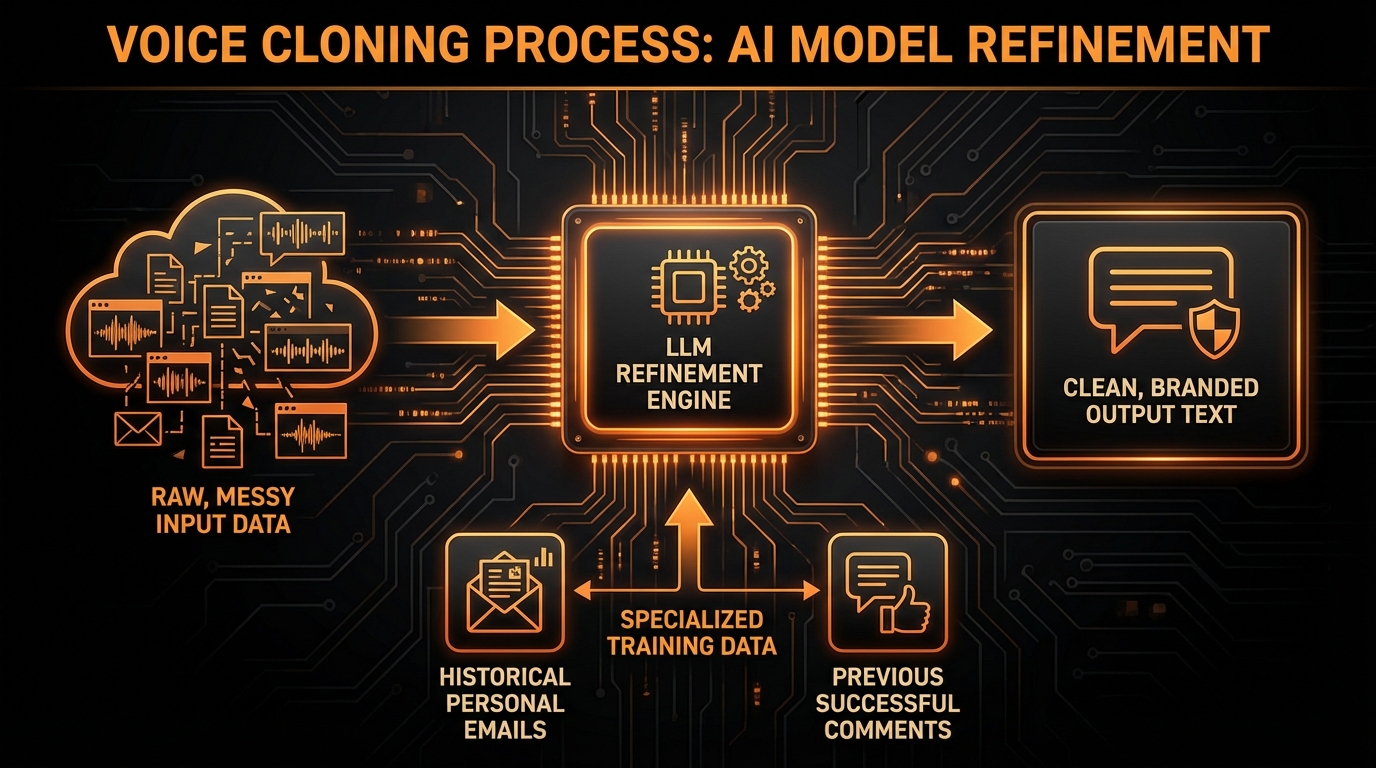
The single biggest vulnerability in AI-driven engagement is “AI Slop”, the overly formal, cliché-ridden language that instantly signals automation. This failure point kills trust and conversion.
To mitigate this risk, you must train the LLM on your specific, authentic voice profile. We enforce a mandatory two-step voice modeling process before any DEPTH-C prompt execution. This ensures every output sounds like a human wrote it at 7:00 AM, not a corporate bot wrote it at 2:00 PM.
Step 4.1: Establish Your Voice Model
Authenticity is non-negotiable in 2025. Before deploying any client-winning prompt, you must provide the LLM with a robust sample set of your human writing. This input guarantees the AI replicates your unique style, not a generic, high-school essay tone.
- Data Collection: Collect 10,15 examples of your best, most authentic writing. Prioritize short-form content: previous high-performing LinkedIn comments, internal Slack messages, or direct sales email snippets.
- Profile Generation: Use the following prompt template to force the LLM to analyze and internalize your style guide.
VOICE CLONING PROMPT: THE ANALYST
Instruction: Analyze the following 15 text samples. Identify my core writing traits based on these criteria: Sentence Length (Short, Medium, Mixed), Vocabulary (Technical, Casual, Expert), Use of Contractions (High, Low, None), Preferred Punctuation, and Overall Tone (Cynical, Pragmatic, Enthusiastic, Direct). Create a 5-point style guide based on your analysis. Then, confirm you will adhere strictly to this style guide for all future outputs in this chat thread.
[PASTE 15 WRITING SAMPLES HERE]
Step 4.2: The Human Feedback Loop in Practice
The ‘H’ (Human Validation) component of the DEPTH-C framework functions as the final quality gate. We do not rely on generic LLM self-critiques. Instead, we mandate training the AI to self-score against specific, high-value human markers focused on eliminating common AI artifacts.
Implement this mandatory checklist as a final instruction layer after the initial output. If the AI fails any item, instruct it to immediately revise the output.
Mandatory AI Self-Critique Checklist:
- Did I use the phrases “diving deep,” “unlocking value,” “seamless integration,” or “synergy”? (If yes, delete and replace with specific, actionable language.)
- Is the comment under 4 lines of text, maximizing scannability on a mobile feed?
- Did the comment directly reference a specific, non-obvious point from the original post, proving I read it?
- Did I use more than one emoji? (If yes, reduce usage to one or zero. Restraint signals authority.)
- Does the language match the established voice model from Step 4.1?
5. Workflow Integration: Scaling Strategic Commenting
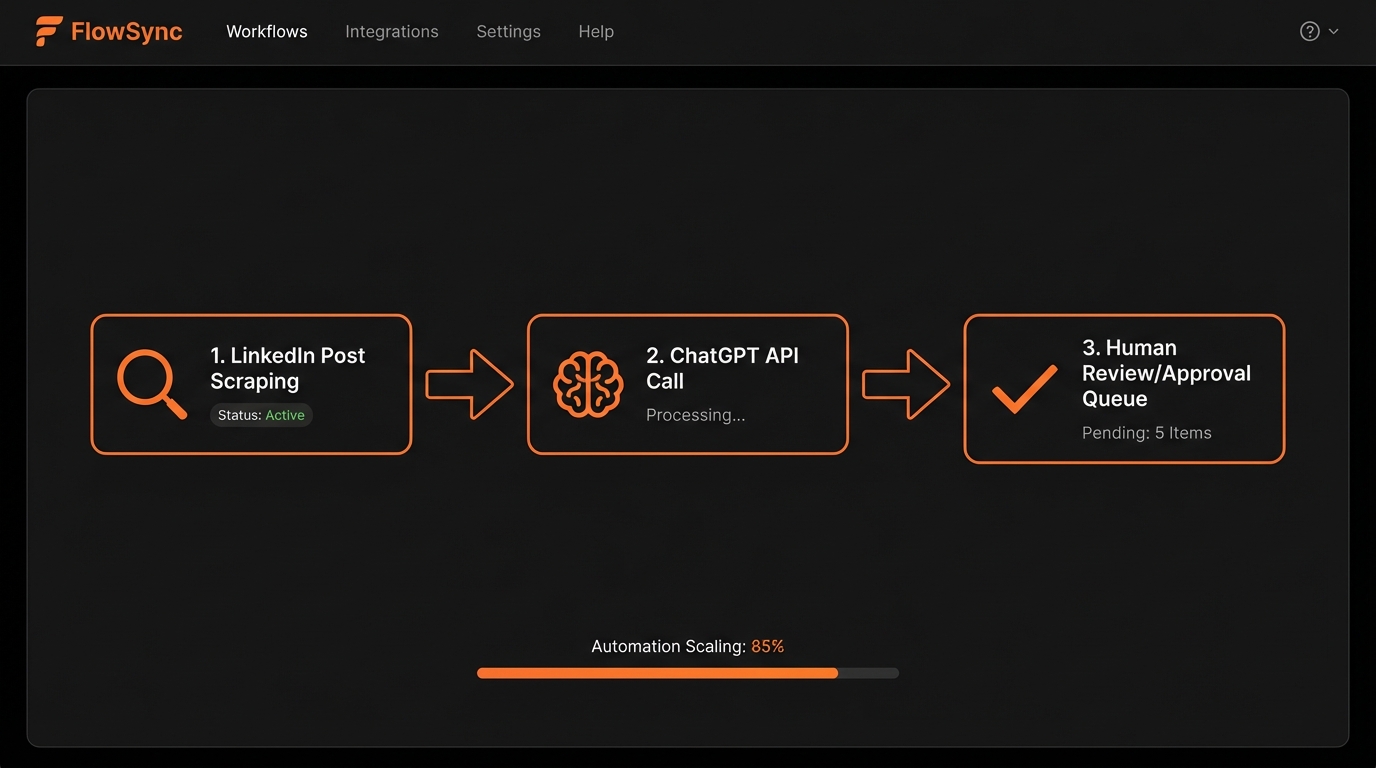
Strategic commenting is ineffective without consistency. Stop relying on intense, four-hour content blocks. We require sustainable, high-access 15-minute bursts integrated directly into the daily sales motion.
This is the optimized daily workflow our top SDRs utilize to integrate these advanced, high-conversion prompts into their client acquisition process:
- Target Identification (5 Minutes Maximum). Utilize Pyrsonalize (or equivalent lead intelligence) to surface 5 high-intent prospects who have posted relevant content within the last four hours. Filter strictly by decision-maker titles (e.g., Founder, VP Sales, Head of Strategy).
- Context Assembly (5 Minutes). For each prospect, open a dedicated ChatGPT thread. Paste the original LinkedIn post, the top 5 existing (high-engagement) comments, and the poster’s exact job title into the context window. This data drives the DEPTH-C engine.
- Prompt Deployment (3 Minutes). Select the specific DEPTH-C prompt (e.g., DM Bridge, Constructive Dissent, Authority Validation) that aligns with the post’s context and your strategic outcome (e.g., initiating a DM). Execute the prompt immediately.
- Human Vetting & Polish (1 Minute). Do not skip this step. Apply the mandatory Anti-Slop Checklist (as detailed in Section 4.2). Make surgical manual adjustments to ensure the output sounds 100% human and authentic.
- Publication and CRM Logging (1 Minute). Publish the refined comment. Immediately log the interaction in your CRM, explicitly